5.3. Labeling. 4:31
Food labelling
Food labeling – words, particulars, trade marks, registered trade name, pictorial matter or symbol relating to a food which appear on the packaging or leaflet.
The particulars must be printed on the packaging or label in such a way as to make them easily legible..
General labelling requirements
- Labelling information must be provided in the official language.
- Additional labelling information may also be provided in foreign languages.
- The labelling of foods must not include therapeutic or preventive properties.
- In the case of non-prepacked foods, the information shall be provided on the documentation or labels.
EXAMPLE OF FOOD LABELLING
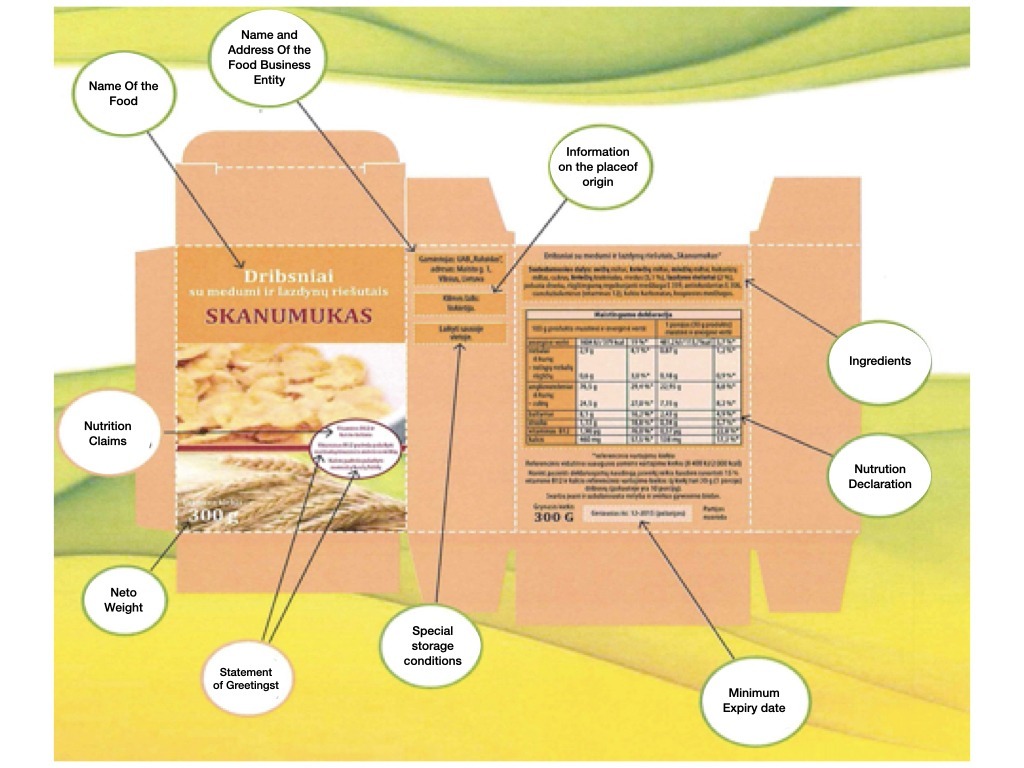
List of ingredients
- The quantity of food ingredients in descending order must be included in the list of ingredients.
- Allergic or intolerant substances must be clearly distinguishable from other elements of the list when choosing font, style or background color.
- Labelling labels must indicate if the product contains more than 0,9% of genetically modified organisms.
Neto weight
- The net quantity of liquids is expressed in litres, centilitres or millilitres, and the quantity of other products in kilograms or grams.
- If the solid food is presented in liquid medium, the labelling shall also indicate the net weight of the food without liquid medium and, in the case of glazed foods, without glazing.
Nutrition declaration
- The nutrition declaration shall include the amount of energy, fat, saturates, carbohydrates, sugars, protein and salt.
- The contents of the declaration may be supplemented by an indication of the amounts of monounsaturated fatty acids, polyunsaturated fatty acids, starch, fibre and vitamins or minerals.
- Information is given in 100 g or 100 ml of the product.
Nutrition and health claims may only be used if they comply with the requirements of the Regulation and are included in the lists of authorised claims.
In nutrition claims it is noted, directly or indirectly, that the product has certain beneficial nutritional or other properties.
In health claims it is noted, directly or indirectly, that categories of food, one or more constituents of a food are in contact with health.
Nutrition and health claims may only be used if they comply with the requirements of the Regulation and are included in the lists of authorised claims.
Minimum shelf life
- The term “Best to …” shall be indicated and the date (date, month, year) shall be entered or the indication of the validity indicated at the labelling point of the package shall be given.
- For foods which are perishable from a microbiological point of view, the minimum shelf life shall be indicated: “Suitable for consumption up to…”
Date of freezing
Date of freezing of frozen meat, frozen meat preparations and frozen unprocessed fishery products or date of first freezing if the product has been frozen more than once: ‘Frozen … (day, month and year)
The name and address of the food business operator (manufacturer, packer, seller or importer to the European Union market) must be indicated on the packaging
Environmental information
Organic food produced and packaged in the EU must bear the EU organic logo.
Organic agricultural and food products grown or produced in Lithuania must also have the trademark “Ekologinis Žemės ūkis”
Symbol “Key hole”
- „The symbol “Key hole” refers to foods with: less fat, less sugar, less salt, more dietary fibre than other products in the same group.
- • It aims to reduce the incidence of cardiovascular, oncological diseases, overweight, obesity, and type two diabetes in Lithuania.
- • This is the International Food Mark approved by the Ministry of Health in Lithuania.